
Experience
The Gravity of the Sun by Jacob Hashimoto
Resin, bamboo, UV prints, Spectra, acrylic, and SS rods
Generously supported by Stanford alumni
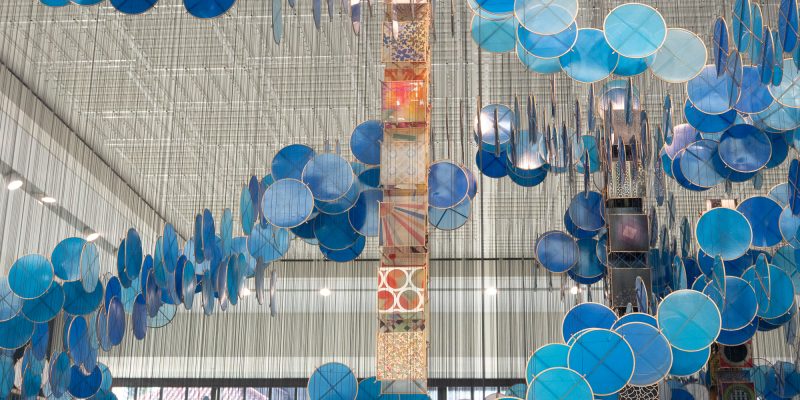
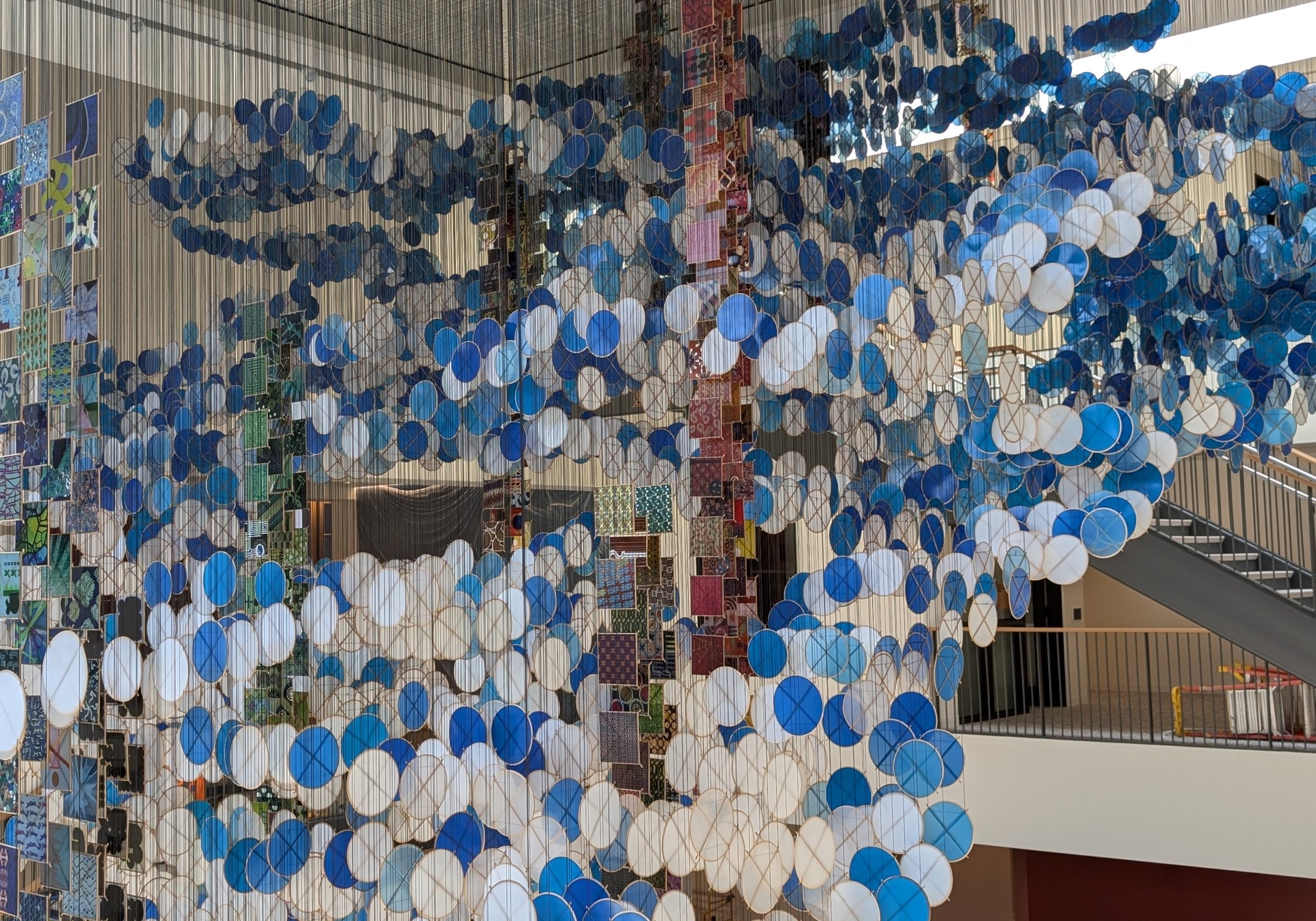
Commissioned specifically for Stanford Graduate School of Education, The Gravity of the Sun suspends histories of pedagogical practice within a diaphanous, cloud-like expanse of white and blue kites.
The kites are composed of handmade washi paper suspended in layers of resin, each with a thin, handmade bamboo frame. The square kites in the columns feature colorful forms and patterns drawn from ideas of pedagogy, invention, translation, interpretation, and linguistics. The team of graphic artists in the studio honed in on marks and shapes that recur throughout shared histories across time—shapes that appear in everything from wheels of Dharma to the secret decoder rings in Cracker Jack boxes; from the cartography of Harappan seals to botanists’ illustrations of plant cells. Suspended within the resin, these myriad graphics on washi paper have the lighting effects of stained glass but seem weightless from below. We see these pillars of kites as collaged columns of erudition: fragments of culture, history, and human achievement are all recombined, repurposed, and reinvented as the viewer visually traverses this constellation of knowledge in the sky.
The title of the work is a reflection on our shared experience of being on the planet: the yearly cycle around the center of our solar system, interpreted here as the myriad ways cultures have developed to explain our world and our experience of it to ourselves and each other.
The artwork contains 6,500 kites, tied using roughly 17 miles of Spectra thread.
Depicting Knowledge Transmission
The primary element of Hashimoto’s artwork is the “kite.” As a symbol of humanity’s connection to the air and to our own aspirations, the kite represents play and possibility. As an artistic element, it works much like a pixel or a brush stroke, making it possible to create large formal gestures that evoke landscape-based abstraction while also providing a collection of individual canvasses upon which we can display a graphic catalog of inspiration. As a whole, this set of graphic kites represents a broad collection of historical styles of knowledge transmission: the ways we teach and share.
The Gravity of the Sun in the news:
- "Art installation inspires curiosity and creativity in education" Stanford Report
Explore the kites of The Gravity of the Sun
Indian Punch Mark Coins

Ancient Indian coinage system (6th-2nd centuries BCE) bearing stamped pictograms of regionally significant animals, celestial bodies, plants, and more.
Egyptian Hieroglyphics

Ancient graphic script containing phonetic glyphs, logographs, and determinatives.
Rongorongo, Various Plant Symbols

As yet undeciphered system of glyphs discovered on Easter Island in the 19th century.
No. 2 Graphite Pencil

The ubiquitous modern writing tool for American students.
ASLwrite

An open-source system of graphic language developed to translate American Sign Language into orthographic script.
Movement Alphabet, Stillness

An open-source system of graphic language developed to translate American Sign Language into orthographic script.
Artist Statement

Jacob Hashimoto (born 1973, Greeley, CO) studied at Carleton College and received his Bachelor of Fine Arts degree from the School of the Art Institute of Chicago in 1996. He lives and works in Ossining, NY.
Using sculpture, painting, and installation, Jacob Hashimoto creates complex worlds from a range of modular components: bamboo-and-paper kites, model boats, even astroturf-covered blocks. His accretive, layered compositions reference video games, virtual environments, and cosmology, while also remaining deeply rooted in art-historical traditions, notably landscape-based abstraction, modernism, and handcraft.
Artist's website: jacobhashimoto.com
Project Team
Jacob Hashimoto, Artist
Wade Cotton, Superabundant Atmospheres, Production, Fabrication, and Installation
Jamisen Ogg, Superabundant Atmospheres, Production, Fabrication, and Installation
Steve Nasker, Pacific Wonderland, Installation Assistance
Erin O'Hara, Jacob Hashimoto Studio, Graphics
Emily Fuller, EmRay Design, Graphics
Brian George, Graphics
Ready to explore? Use our Public Art App to navigate Stanford’s full collection of public art.
Cantor Collection
Learn more about the works of outdoor art in the collection of the Cantor Arts Center, including the Rodin Sculpture Garden, or join museum docents for a campus art walking tour.
Campus Public Art Proposals
Members of the Stanford community (students, faculty, and staff) can submit proposals for temporary public art projects on campus. Proposals are reviewed by the Office of the Vice President for the Arts.
Public Art Committee
Stanford’s Public Art Committee is responsible for overseeing a strategic plan for public art, including both outdoor art and art in public spaces of academic buildings and other campus facilities. The committee aims to make Stanford a destination for public art, drawing on the university’s unique natural and built environment, and to create an experience of creative vitality for all visitors to Stanford’s campus.